

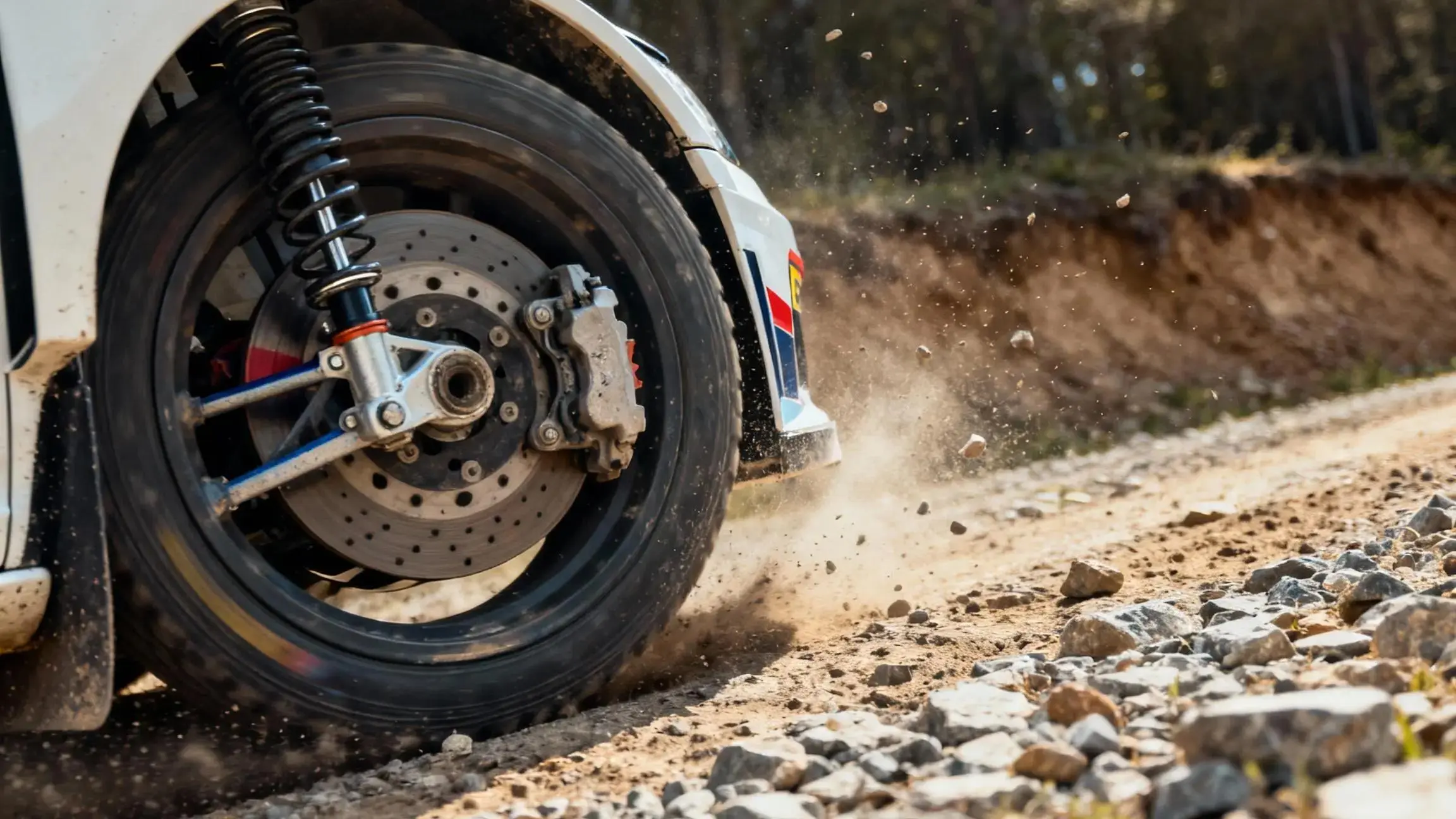
Rally racing suspension is a specialized system designed to keep your car stable, responsive, and in control over every unpredictable surface—gravel, tarmac, ruts, and jumps.
It uses advanced dampers, reinforced components, and tailored geometry to maximize wheel contact and grip, transforming your vehicle into a true rally performer.
Understand the Demands of Rally Racing Suspension
Rally racing isn’t just motorsport. It’s a brutal test of how well your suspension maintains grip, control, and feedback through high-speed jumps, endless ruts, deep gravel, and unpredictable landings. If you want to drive hard and stay safe, you have to take your suspension setup seriously. Understanding what sets rally suspension apart is essential.
Core Demands That Define Rally Suspension:
- Massive travel for absorbing jumps and deep ruts, keeping your tires on the ground through chaos.
- Advanced damping to handle both slow, sweeping load transfers and fast, violent impacts from rough terrain or landings.
- A strong, serviceable build with reinforced mounting points that survive repeated punishment without losing alignment or geometry.
- Adaptability for mixed surfaces: Your setup must handle transitions from gravel to tarmac, snow, or mud with confidence.
You can’t fake performance in rally. If you’re not maximizing tire contact and keeping your chassis controlled, you’ll lose speed, risk damage, and destroy driver confidence.
Rally suspension must deliver predictable reactions over terrain, so you trust the car at the limit.
Sticking to track or street setups won’t cut it. Rally systems trade some daily comfort for strength, clarity, and resilience where it really counts.
How Rally Loads Stress Suspension
Mixed surfaces throw everything at your setup. Think rocks, potholes, compressions, loose dirt, and heavy landings. Effective rally suspension offers:
- Adjustability to manage both low- and high-speed bumps for compliance or control as needed.
- Durable bushings, reinforced control arms, and robust mounts to withstand repeated shocks.
- Rebuildability, so you can freshen hardware between events—oil loss or worn seals mean unpredictable handling.
You want your suspension to react the same every stage. Consistency lets you push limits and make your own pace, regardless of what’s hiding around a blind corner.
Break Down the Anatomy of Rally Racing Suspension Systems
Every part of a rally suspension system exists for a reason. Let’s dig into why each component matters and highlight what separates a true rally build from a basic upgrade.
Key Components and Why They Work
A rally suspension is not just springs and shocks. It’s a carefully tuned system where every part has a job.
- Progressive springs: Provide a soft initial response for small bumps while stiffening up to prevent bottoming on rough terrain. This gives both comfort and control.
- Monotube or inverted shocks: Offer increased oil capacity, better heat dissipation, and serious impact resistance—essential for repeated landings or harsh ruts.
- Reinforced bushings and mounts: Prevent unwanted movement and protect geometry, stopping small impacts from becoming big alignment headaches.
- Adjustable damping (high/low speed): Lets you fine-tune ride response for different stages. You can chase more grip on loose surfaces or stiffen things up for tarmac.
- External reservoirs: Help manage thermal buildup, keeping shocks consistent even over long, punishing stages.
- Model-specific fitment: Critical. Every chassis has unique travel limits, mount geometry, and control arm angles. “Universal” solutions often fail here.
Bulletproof construction is non-negotiable. Shock travel and valving must match your car and your rally’s terrain; too little travel risks frequent bottoming, while the wrong damping leads to uncontrolled movement or snap loss of grip.
A proper rally suspension must be as tough as the surface you drive.
What Sets Rally Kits Apart
Look for these non-negotiables in a true rally system:
Must-Have Features:
- Extra travel over stock, with damper stroke matched to expected jump height and terrain shape.
- Larger or inverted piston rods for strength and reduced flex.
- Serviceable and re-buildable components for fast inspection, tuning, and repair.
- Progressive or dual-rate springs paired to specific stage profiles.
- Robust hardware—no shortcuts on fasteners or materials.
If you run Miata NA/NB platforms, solutions like “rallycross coilovers for NA/NB Miata” exist to give the needed extra clearance and strength. On most vehicles, sticking to tested, rally-specific setups pays off immediately in reliability and control.
Explore How Rally Suspension Differs From Regular and Track Setups
You can spot a rally build from a mile away. High ride height. Fat tires. Visible travel. Why does it look so different? Because rally suspension is all about control on uneven, unpredictable ground—conditions you’ll never find at a track day or on the street.
Why Standard Kits Fall Short
Regular or track suspension:
- Offers limited travel, focused on low ride height for a better center of gravity and aero.
- Uses lightweight, precision parts that don’t cope well with repeated hard knocks.
- Runs tight alignment settings that easily knock out of spec over a single rock or jump.
Rally racing demands:
- Extra ground clearance and tall, compliant tires to avoid bottoming and wheel damage.
- Simplified, conservative alignment so impacts don’t turn your setup into a liability.
- Stout, easy-to-inspect arms and mounts that take hit after hit.
- Geometry built for stability and grip, not just fast steering response.
Rally suspension trades cosmetic stance for raw, mechanical grip where it counts.
Rally vs. Road and Track: What Changes?
Adjust your thinking around these:
- Increased ride height: Adds clearance so rocks and ruts don’t wreck your day.
- More suspension travel: Lets your wheels follow the ground and keep traction even off a jump.
- Sturdier hardware: Track arms might bend. Rally arms shrug it off.
- Predictable over perfection: Rally teams avoid aggressive camber or toe. Conservative and consistent wins stages.
If you fit oversized wheels for brake clearance, balance them for weight—unsprung mass kills response. Lowered coilovers belong on smooth tarmac, not rally stages.
Learn How to Tune Rally Racing Suspension for Surface and Conditions
Tuning your suspension for different rally surfaces separates winners from everyone else. One setup never covers all stages. You need to know how and when to adjust—fast.
Every surface brings unique demands:
Setup Basics and Tricks for Every Surface
What to Tweak and Why:
- Gravel: Go with softer springs and damping. This helps tires mold to loose surfaces and digest constant small hits. Raise ride height and pick chunkier tires for durability.
- Tarmac: Move to firmer springs, more compression damping, and lower ride height. This locks down body motions for maximum grip.
- Snow or mud: Soften things up. Extra ride height and tire flexibility matter more than wild geometry.
Don’t just trust theory—test on short loops before a stage.
Quick-Adjust Checklist for Tuning Success
- Adjust low-speed damping to dial in how your car reacts to braking and turn-in.
- Increase high-speed compression to survive big jumps without bottoming.
- Set rebound so wheels return to the ground quickly but don’t pogo.
- Go stiffer on springs and roll bars for tarmac; soften for rough gravel or dedicated jump sections.
- Use progressive bumpstops or hydraulic top-outs to cushion big landings.
Keep your rally alignment conservative. Aggressive settings are more likely to go out of spec after an impact, and you’ll spend more time in the pits than on stage.
Changes are only as good as your feedback and record-keeping. Test, document, and iterate after every run.
You don’t get a perfect setup the first time. Ongoing tuning—plus a willingness to trust your feedback over hype or trends—sets you up for success. Pair a rebuildable, rally-bred damper with data and adjust every stage. Systematic, disciplined tuning is how you unlock genuine speed and reliability.
Integrate Wheels, Tires, Aero, and Chassis Into the Suspension Equation
Rally suspension is only part of the system. The real gains come when every component works together—wheels, tires, aero, and chassis all play a role in getting power down and keeping your car planted.
You want more grip and faster response? Look at the package, not just one piece. Here’s where most builds fall short.
Wheels, Tires, and Unsprung Mass
Tire profile, sidewall stiffness, and wheel weight change everything about suspension feel and effectiveness.
- Lightweight forged wheels: Drop unsprung mass, letting your dampers react quicker and grip more. That means sharper turn-in over ruts and less bounce when the pace picks up.
- Wheel diameter and brake clearance: Bigger wheels let you run large brakes, but add weight that drags on suspension performance. Value clearance, but don’t chase size for looks.
- Sidewall height: Tall gravel tires soak up impacts and shield rims from rocks. Shorter, stiffer sidewalls give quick direction changes but punish you on anything rough.
The tire is part of your suspension, not just the last contact point.
Lower wheel weight and smarter tire choice give you a suspension advantage with every bump.
Aerodynamic Balance and Chassis Stiffness
You can’t talk grip without addressing airflow and structure.
- Quality carbon fiber aero manages high-speed airflow, lowering lift and calming stability at the limit. Our carbon parts, like those from ASM Design, smooth out the air so your chassis and suspension don’t have to do all the heavy lifting.
- Body kits, spoilers, and splitters control underbody turbulence. They keep the car predictable, so you feel at home as speed climbs.
- Chassis reinforcement—strut braces, seam welds, and a roll cage—tighten the frame. A rigid shell lets suspension do its job, keeping your changes consistent and repeatable.
The right blend of aero and suspension upgrades doesn’t just look fast. It delivers control you can feel in every stage.
Avoid Common Suspension Setup Pitfalls in Rally Racing
Too many rally builds fail for the same avoidable reasons. If you want real results, avoid these mistakes.
Costly Suspension Missteps and How to Dodge Them
- Buying generic “magic” coilovers that promise everything but offer poor travel and the wrong valving.
- Fitting lowering kits to save money—only to bottom out or wreck components on the first rough section.
- Skipping reinforced mounts or bushings, turning minor hits into major geometry problems.
- Choosing oversize wheels for style instead of durability and protection, risking rim damage and less grip.
- Ignoring routine inspections or running components past their prime—worn seals or leaking shocks mean unpredictable behavior.
Failure to plan for service leaves you exposed. Carry spares, check after every major stage, and keep service parts on hand.
Predictable, robust setups win over trendy or untested upgrades every time.
Cut complexity. Stick to incremental, testable changes. The fastest way to confidence is with bulletproof parts, not wishful thinking.
Understand the Importance of Model-Specific Engineering and Professional Support
A winning setup starts with engineered parts built for your car. Each chassis has unique angles, travel limits, and quirks—universal solutions rarely deliver peak results.
Why Model-Specific and Expert Support Matters
- Model-specific coilovers or arms ensure the right geometry, damper stroke, and clearance, minimizing risk of binding or catastrophic failure.
- Professional brands give you rebuildability and access to baseline settings tested under actual rally conditions.
- Integration with other upgrades—suspension, wheels, aero—demands precise fitment. At ASM Design, we guarantee our aerodynamic parts sync with high-performance builds, so friction and interference never rob you of speed.
- Dedicated support, setup advice, and warranty protect your investment and fast-track your learning curve.
You get a safer, more trustworthy car. And you save time by avoiding mistakes others have already paid for.
Fitment clarity, expert support, and proven solutions separate winning builds from Frankenstein projects.
Choose people who understand the stakes and stand behind their hardware.
Transform Your Mindset: From Parts Collection to Integrated System Thinking
The best rally cars are not just a pile of expensive parts. They are ultra-focused, system-based builds where everything works in unison.
Start thinking like an engineer, not just an enthusiast.
Key Steps for True Rally Performance Mindset
- Treat every change as part of a system. A heavier wheel changes suspension needs. Adding front downforce? Adjust your spring and damper rates.
- Keep detailed notes. Every setup tweak, measured, tested, and logged—so you know what works.
- Choose upgrades that deliver measurable improvement: less mass, better fitment, clearer response.
- Build your test plan. Stage-based trials, not last-minute tweaks before the race.
Integrated systems win. Disjointed parts lose.
When you get clear on the cause and effect in your build, you get more speed, more safety, and more fun.
Conclusion: Take Your First Step Toward True Rally-Ready Performance
The ultimate rally racing suspension setup isn’t a magic part or shortcut. It’s an integrated strategy—model-specific suspension, precise wheels, quality aero like our carbon fiber upgrades from ASM Design, and expert support—all tuned for your car and goals.
Clarity and system thinking bring results. If you’re ready to step up, explore our aerodynamic solutions or reach out to our team. Together, let’s make your next rally build unstoppable.
